Online European Roulette in the UK: Rules and Odds
 Available in GB
A practical guide to single-zero odds, roulette bets, live and RNG tables, and the terms that separate free play from real-money play.
Table of Contents
- What the Single Zero Changes
- Choosing a UK Casino Without Buying the Hype
- Playing a Round: Bets, Payouts and the Martingale Trap
- RNG Spins, Speed Tables and Live Wheels
- Single-Zero Bets and the La Partage Exception
- Free Play, Real Money and the Bonus Small Print
- Reading the Roulette Table: Inside and Outside Bets
- When a Roulette Game Is Really a Slot
- Live Dealer Roulette: What the Camera Shows—and What It Doesn’t
- European vs American Roulette: The Extra Zero Has a Cost
What the Single Zero Changes
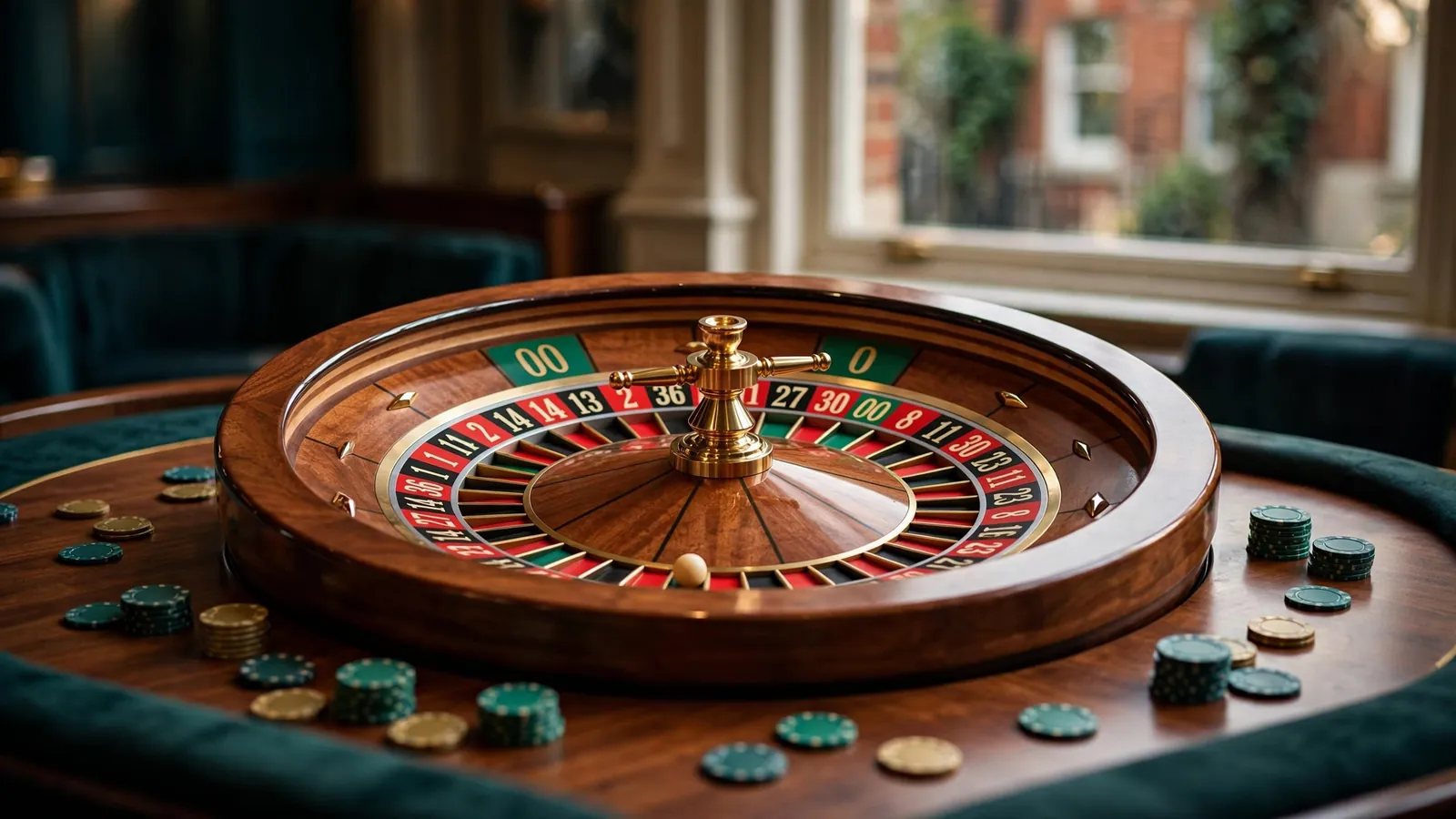
A European roulette wheel has 37 pockets: the numbers from 1 to 36, plus one green zero. That single pocket is the reason the game has a house edge of 2.70%. It is easy to look at the zero as just another place for the ball to land. I did that for a while. But it is the pocket that gives the casino its mathematical advantage.
The edge is not a prediction about what happens on the next spin. It does not mean the wheel will take a fixed share of your money every time you play, or that a win is overdue after a run of losses. It describes the built-in difference between the game’s odds and the payouts it offers over time. On any individual spin, the ball can land anywhere. The zero does not remember what happened before.
That distinction sounds obvious when written down. At a table, with a run of results in front of you, it is much easier to start seeing patterns. I have caught myself thinking a certain result must be coming because it had not appeared for a while. That is the trap: a wheel’s previous spins do not tell you what the next one will be. Each result is determined by chance.
When choosing an online casino for European roulette in the UK in 2026, payout timing is one practical detail to check. Use these verdicts as a quick reference when considering your options.
Payout speed: 1-3 business days Britsino lists a payout speed of 1–3 business days. You can use that estimate as one factor when considering it for European roulette.
Payout speed: 1-3 business days x3bet lists a payout speed of 1–3 business days. You can weigh that timing when deciding whether it suits your European roulette plans.
Payout speed: 1-3 business days Revery Play lists a payout speed of 1–3 business days. You have that stated timeframe to consider when choosing where to play European roulette.
Payout speed: 1-3 business days NightWin lists a payout speed of 1–3 business days. You can factor in that estimate as you consider it for European roulette.
Payout speed: 1-3 business days SpinFormula lists a payout speed of 1–3 business days. You can keep that payout estimate in mind when considering it for European roulette.
Payout speed: 1-3 business days EvoSpin lists a payout speed of 1–3 business days. You can use the stated timing as one detail in your European roulette choice.
Payout speed: 1-3 business days Zombillion lists a payout speed of 1–3 business days. You can consider that estimate when deciding whether it fits your European roulette plans.
Payout speed: 1-3 business days Dieselwin lists a payout speed of 1–3 business days. You can take that timing into account when considering it for European roulette.
Payout speed: 1-3 business days SlotoSport lists a payout speed of 1–3 business days. You can use this stated estimate as one point of reference for European roulette.
Payout speed: 1-3 business days BeOnBet lists a payout speed of 1–3 business days. You can factor that estimate into your decision about where to play European roulette.
Why one pocket matters
The 36 numbered pockets are split between two colours, while the zero is green. Its presence means the wheel has a result that does not belong to either colour. That changes the balance behind bets based on broad categories, even though the layout may make those bets look close to an even contest.
The same underlying imbalance affects the game as a whole. A payout can look generous, and a result can feel unlikely, but the rules are designed so that the amount returned does not fully match the chance of winning. The gap is what the house edge measures. European roulette’s 2.70% edge is comparatively straightforward to understand because the wheel has a single zero, but “single zero” does not mean “no house advantage”.
This is where advertising language can get slippery. “Fair” may mean that the game follows its stated rules; it does not mean that the player and casino have identical odds. “Low edge” is a comparison, not a promise that your session will end in profit. The zero still counts.
If you are looking at an online casino offering European roulette in the UK, the wheel’s pocket count is a useful starting point for understanding the game, not a reason to assume that every table or rule is identical. The name tells you the basic wheel format. It does not, by itself, tell you every detail of a particular game. I would rather know what rule is actually in front of me than rely on a label that sounds reassuring.
The edge is not a session forecast
The 2.70% figure is useful for comparing the mathematical structure of a game. It is not a guide to how much you will lose during a short visit. A player can leave ahead, or lose quickly; neither outcome disproves the edge. Chance can produce uneven results in the short term, and the longer-term average is not a schedule that the wheel follows.
That mattered to me because I used to treat a percentage as if it were a personal forecast. I would see the number and try to translate it into what I could expect from the next stretch of play. That is not what it says. It describes the game’s design across repeated wagering, not the result of a particular spin or a guarantee about an individual’s balance.

A useful way to keep the idea grounded is to separate two questions. First: what can happen on the next spin? Any pocket may receive the ball. Second: how are the payouts set against those possible results? That second question is where the house edge comes in. Mixing them up makes the game feel more predictable than it is.
The single zero is therefore not a lucky symbol, a warning sign, or a clue about what comes next. It is part of the wheel’s structure. It helps create the difference between the chances of an outcome and the return attached to it. Once you see that, the 2.70% edge stops sounding like a vague technical footnote and starts explaining why the casino has an advantage even when a player can win.
No secret pattern. Just chance.
Choosing a UK Casino Without Buying the Hype
A polished roulette page can make an operator look more trustworthy than it is. I’ve learned not to treat neat design, familiar game names or a “best” badge as proof of anything. Before I deposited, I’d check who is legally responsible for the casino and whether the information I need is easy to find.
For customers in Great Britain, the UK Gambling Commission (UKGC) is the sole regulator of online casino activity. A remote operator selling gambling to people here must hold the relevant UKGC licence, wherever the company is based. A site without a valid UKGC licence cannot legally offer real-money roulette to British residents. That makes the licence a basic access check, not a quality award.
Look up the operator on the UKGC’s public register and make sure the licence is current and covers the gambling activity being offered. Don’t rely on a logo in a website footer: it is only a claim until you verify it. I’d also check that the operator name on the register matches the business named in the site’s terms. If the details don’t line up, I wouldn’t deposit while trying to explain the mismatch away.
RTP should be findable
RTP information should be accessible when you’re considering a UKGC-licensed roulette game. Look for it in the game’s information panel or help menu, and check that it relates to the particular version you’ve opened. If you can’t locate it, ask customer support where it is; a clear answer is more useful than a banner calling the game “fair” or “premium”.
RTP is not a promise about what will happen during your session. It describes a game’s return measure, not a result you can count on. I used to read a percentage as reassurance that a short run would behave sensibly. It doesn’t work like that. The practical test here is whether the operator makes the information available and explains what it applies to, not whether the number sounds appealing.
Be wary of pages that bury important details beneath promotional language. “Exclusive” may just mean a particular game is being advertised; “trusted” is not evidence of a licence. I’d rather spend a minute checking the register and game information than take a slogan on trust. Less shine. More checking.
Safeguards are part of the service
A UKGC-licensed casino should make its safer-gambling controls visible and usable. Operators must prompt new customers to set a financial limit before their first deposit, and provide accessible account-level controls for changing limits. They must also offer deposit limits, loss limits, session-time reminders, reality checks, cool-off periods and GamStop self-exclusion. These aren’t decorative links for the footer; they are tools you should be able to locate before you need them.
Age verification must happen before an operator allows you to deposit into a gambling account. Check the site’s terms and account information to understand its verification process, and don’t treat a quick sign-up screen as evidence that no checks apply.
UKGC licensees must offer an internal complaints process and access to an approved Alternative Dispute Resolution service. If something goes wrong, the site should explain how to raise a complaint and where to go if it remains unresolved. Operators are also required to contribute to the Research, Education and Treatment levy. You may not notice that while choosing a game, but it is part of the regulatory framework behind licensed gambling.
Verifying Your Casino
- Look up the operator on the UKGC public register
- Verify that the licence is current and covers the gambling activity
- Match the operator name on the register with the business name in the terms
- Locate the game’s RTP information in the help menu or info panel
- Ensure account-level safer-gambling controls are visible and usable
Payment rules are another useful reality check: UKGC-licensed casinos cannot accept credit cards for gambling, including through a money service business, and cannot accept wallet payments that let credit-card funds be used for gambling. If a site presents a credit card as a way to fund roulette, stop and verify what you’re looking at.
None of these checks tells you that a casino is “the best” for you. They do help separate a legally accountable operator from a convincing-looking page. I’d start with the register, find the game’s RTP information, then make sure the account controls and complaints route are plainly available. If any of those basics take too much digging, I’d move on.
Playing a Round: Bets, Payouts and the Martingale Trap
When I first started playing online roulette, I treated the buttons and numbers on the screen as the hard part. They weren’t. The more important habit was slowing down long enough to check what I had actually staked and what a win would pay.

A round is straightforward: choose a stake, place it on the bet you want, and check the displayed total before betting closes. Once the spin is under way, that wager is set for the round. After the result, the game settles the bet and shows any return. The exact controls differ between games, so I take a moment to read the screen rather than assume it works like the last table I used.
A payout describes the profit on a winning bet, not necessarily the full amount returned to your balance. For instance, a straight-up bet on one number pays 35:1. That means a winning stake earns 35 times its value in winnings, with the original stake also returned. It does not mean the bet is likely to land. A larger payout reflects the bet’s lower chance of winning; it is not a hint that a particular number is due.
That distinction is easy to lose when you are watching a run of results. I have caught myself thinking a number had to appear after staying away for a while. It didn’t. Each spin is determined by chance, and no betting system can predict the final outcome. The previous result may feel like a clue, but it does not make the next one more readable.
The Martingale is a neat example of how a system can sound persuasive while leaving the underlying odds untouched. You double your bet after each loss, hoping that a later win will recover earlier losses and leave a small gain. The catch is that you need enough money to keep increasing the stake, and a losing streak can make those increases painful. Your bankroll can take the hit before a win arrives.
I tried the logic myself: after a loss, the next larger stake seemed like a way to take control. It wasn’t. Doubling changes the size of what you stand to lose; it does not change the wheel or make a win more likely. A run of losses can carry on, and each step asks you to risk more than the last.
Martingale Risk
A losing streak can quickly exhaust your bankroll because doubling stakes increases the amount you stand to lose without changing the wheel’s odds.
If you want to play European roulette online, decide the amount you are comfortable staking before the round starts, then treat the displayed payout as information—not a promise or a route around chance. I now pay more attention to the stake than to a system’s confident name. Less exciting. Safer thinking.
RNG Spins, Speed Tables and Live Wheels
The first difference I notice when choosing a European roulette game is not the wheel layout but the way each spin arrives. Some versions use software to generate the result; others show a physical wheel on a live stream. The rules may feel familiar, but the pace and atmosphere can be quite different.
RNG roulette uses a random number generator to simulate each spin. There is no dealer waiting for bets to close and no ball travelling around a wheel on screen: the software produces a result, then moves on to the next round. That makes it a brisk option if you want to play without the pauses of a streamed table. Minimum stakes can also be low; some RNG games start at 10p.
Fast can be useful. It can also make it easier to lose track of how quickly you are placing bets. I used to treat a rapid run of spins as a reason to stay in the game, as if the next result were due sooner. It isn’t. A quicker interface changes the rhythm, not the chance behind an individual outcome.
There is a separate format called speed roulette. A specialist review reports that it can run at more than 150 spins per hour, compared with 80–100 at a standard table. Those figures describe the pace reported for those formats, rather than a promise about every game you might open. If you are comparing options, check the table’s own information and watch a few rounds before deciding whether that tempo suits you.

A live dealer game trades some of that speed for a more physical setting. You see a real wheel in a studio, a human dealer and the ball dropping into a pocket. The stream gives the round a visible sequence: the dealer prepares, bets close, the wheel turns, and the result is announced. That can feel less like clicking through software and more like sitting at a table, though the experience still arrives through a screen.
The pace figures available for American roulette show how much delivery format can matter: RNG versions are described as running at 150 to 200 or more spins per hour, while live-dealer play is put at 50 to 60 spins per hour. Those figures are specifically about American roulette, so I would not use them as a fixed estimate for every European game. The useful point is the contrast: software can move quickly, while a streamed wheel includes the human and broadcast steps of a live round.
When I want a short, straightforward session, RNG play is less waiting. When I want to watch the wheel and dealer, live play gives me more to follow between bets. Neither format makes roulette predictable, and speed is not an advantage if it nudges you into playing longer than you meant to. Pick the pace you can comfortably manage. No magic setting.
Single-Zero Bets and the La Partage Exception
A single-zero wheel has one outcome that can make an even-money bet feel less straightforward: zero. If you have backed red or black, odd or even, or low or high, the bet is normally settled as a loss when the ball lands there. The colour and number grouping do not rescue it. Zero is its own result.
On a standard single-zero table, an even-money bet (such as red or black) is settled as a loss if the ball lands on zero.
That can be easy to forget while watching a run of familiar outcomes. I have treated an outside bet as if it were simply a coin toss with a wheel attached. It is not: the green pocket means those bets do not win on every result that is not the opposite side. That small distinction is where the house edge comes from.
La Partage changes the settlement. On a table that offers the rule, a qualifying even-money bet does not disappear in full when zero comes up: half is returned, and the other half is lost. So a stake on red, for instance, leaves you with half of it rather than nothing. It is a better outcome than losing the whole stake, but it is not a win.
The rule is not automatic
La Partage is an option, not something to assume from the words “European roulette” or from seeing a single-zero wheel. Two games can look almost identical while applying different rules to zero. Before staking money, look at the table information or rules panel and confirm whether La Partage is actually in force, and which bets qualify.
That check matters because the improvement is specific. It applies to even-money bets, not every betting choice on the layout. A number-based bet does not become half-refunded just because the wheel has one zero. If the rule is not listed, do not build your expectations around it.
With the rule applied to qualifying bets, the house edge on those bets falls to 1.35%, compared with the standard European roulette edge of 2.70%. That is a meaningful difference in the maths, but it does not make a spin predictable or turn an outside bet into a reliable way to win. The ball still has to land somewhere, and zero can still cost you part of your stake.

I used to skim game rules because the layout looked familiar. That was a lazy habit. The wheel tells you what outcomes exist; the rules tell you how your wager is settled when one of them lands. With La Partage, the crucial detail is not just that zero is present, but whether the table returns half of a qualifying even-money stake on that result.
If you are comparing tables, treat La Partage as a rule to verify, not a feature guaranteed by the roulette label. Read the wording before you play, especially if you are choosing a game because its even-money bets appear less exposed to zero. A partial refund softens that particular loss. It does not remove the risk, and it does not apply unless the table says it does.
That is the useful distinction: on an ordinary single-zero table, zero defeats an even-money bet; with La Partage, half the stake comes back. Small rule. Real difference.
Free Play, Real Money and the Bonus Small Print
A free European roulette game is useful for seeing the interface and getting a feel for its pace without staking cash. A demo does not, though, recreate the decisions that come with real-money play. There is no balance you can lose, and any demo credits or results are not money you can withdraw. I used to treat a few comfortable demo sessions as proof I had the game figured out. They proved no such thing.
Attention! Bonus terms often restrict how much roulette wagers count toward wagering requirements, with some live versions contributing as little as 0% to 20%.
With European roulette for real money, your balance is at stake, and bonus terms may add another layer. A welcome offer can look generous until you check whether roulette is eligible and how much each wager counts towards its wagering requirement. “Included” can mean very little. If only a fraction of your roulette stake counts, progress will be slower than the headline suggests.
The rules vary by operator and sometimes by format. Operator terms and specialist casino reviews describe roulette wagers as counting at 10% to 20% towards wagering requirements at many UK operators. Other published comparisons report that live roulette may count at 10% or 20%, while RNG roulette can count at 100%. Those figures are not a promise about any particular offer: check the terms attached to it, not a general guide.
No-deposit bonuses can be tighter still. Some UK operators exclude live roulette from wagering on these offers; where it is included, a specialist review reports contribution rates from 0% to 10%. That range is a reason to read the offer’s own rules, not to assume live play qualifies. Terms can also distinguish between bonus funds and cash in your account, so check which balance a wager uses and what happens when the offer ends.
A specialist regulatory review says that, from January 2026, UK-licensed operators are subject to a maximum bonus wagering requirement of 10x. That does not mean every offer has the same requirement, or that every game contributes equally. The game-weighting rule still matters: a lower headline requirement can be less useful if roulette barely counts towards it.

If you are trying a European roulette demo, treat it as a way to inspect the game, not a rehearsal that predicts real-money results. And if you accept bonus funds, read the eligibility and game-weighting clauses before you play. I have skipped that small print before. It was not small.
Reading the Roulette Table: Inside and Outside Bets
A European roulette table can look busy until you notice it is arranged in two broad zones. The numbered grid in the middle is where you place inside bets: wagers tied to a particular number or a small group of neighbouring numbers. Around its edges sit the outside bets, which cover broader groups such as colours, odd or even numbers, and high or low numbers.
On a standard European layout, the numbered spaces run from 1 to 36, with the single zero set apart in green. The betting boxes line up with the wheel’s numbers, but the table is not a map of the wheel’s physical order. I used to assume the layout was trying to hint at a pattern. It isn’t. It is a way to place and identify wagers.
The smallest inside bet is a straight-up bet: put your chip on one number. If that number wins, the payout is 35:1 on European roulette. A split covers two adjacent numbers, with the chip placed on the line separating their boxes; its payout is 17:1. For a street bet, place the chip at the end of a horizontal row of three numbers. That pays 11:1.
Those payouts are not a signal that one choice is cleverer. They reflect how many numbers the bet covers. A single-number wager has a larger payout than a street because it covers less of the grid. I’ve been tempted by the big number beside a bet and ignored how narrow the target was. Easy mistake.
Straight-up Payout
Example: 35:1 × £1 = £35 winnings (plus the £1 stake returned).
Outside bets sit beyond the numbered grid. Red or black, odd or even, and high or low are the familiar examples; each pays 1:1. They are simpler to spot and cover a wider set of possible results than a bet on one number. The table also groups numbers into larger sections, so take a moment to check which marked area your chip is actually on before confirming it.
On a digital European roulette table, the same layout may be compressed to fit a screen. Tap a number for a straight-up bet, or look for the lines and outer boxes before choosing a split, street or outside wager. If the display is small, zoom in rather than trusting a hurried tap. I’ve misread a position when rushing. Not a strategy.
There is no magic region of the European roulette table layout that makes a result predictable. Learn where each bet belongs, then choose based on the coverage and payout you understand—not on a pattern you hope the grid is hiding.
When a Roulette Game Is Really a Slot
A roulette-style screen does not automatically mean you are playing roulette. I learned to look past the felt, wheel graphics and dramatic ball animation: what matters is the game’s rules. In a standard roulette game, you bet on a physical or simulated wheel outcome. A slot uses its own game structure, even when its presentation borrows roulette imagery.
That distinction matters when a title includes words such as “European roulette”. The label may describe the theme, but it does not by itself tell you that the game has a European wheel, the same outcomes as one, or European roulette odds. A slot’s rules and paytable are the things to inspect. If those are not clear, the artwork is no substitute.
The same goes for searches for a 3D European roulette slot, or games described as European roulette Gold or Platinum. Those phrases can sound like formal roulette variants, but a name or visual treatment does not establish how the game works. Check whether the rules actually describe a roulette wheel and its outcomes. If instead they describe reels, symbols or a slot paytable, you are looking at a slot-style game.
Book of Dead is a useful contrast: its name and presentation belong to a slot, not a roulette table. XXXtreme Lightning Roulette also needs a careful look rather than an assumption based on the word “Roulette”. It is a roulette-themed slot title, not a standard roulette wheel. The resemblance in the name does not make the games interchangeable.
I used to treat a familiar-looking layout as a shortcut. It isn’t. A wheel image can make a slot feel recognisable, but it cannot tell you what determines a result or what a winning combination pays. Read the game information before you stake anything, and do not carry assumptions from roulette over to a slot.
There is a practical difference, too: roulette odds describe bets on wheel outcomes. A slot’s rules define its own possible results and payouts. So a roulette-themed slot should not be judged as though a straight-up roulette bet or another table wager were sitting underneath the graphics. Different game. Different rules.
- Check the game rules to confirm if it uses a roulette wheel
- Inspect the paytable to see if it describes reels and symbols
- Treat roulette-themed slots as slot games
- Assume a “European roulette” title guarantees roulette odds
- Rely on wheel graphics to determine the game type
- Apply roulette betting strategies to slot-style games
If you want roulette, choose a game whose rules actually set out roulette play. If the appeal is the slot presentation, treat it as a slot and assess it on its own terms. The title is only a title.
Live Dealer Roulette: What the Camera Shows—and What It Doesn’t
With live dealer roulette, you’re watching a real wheel in a studio, not an animation generated on your device. The stream shows a human dealer launch the ball and the physical drop that decides the result. That makes the round feel more tangible to me; I can see the wheel and follow what happens rather than just waiting for a graphic to resolve.
But a camera is still a camera. It shows the view the studio provides, not every part of the operation behind it. I wouldn’t treat a polished set or a friendly dealer as proof that an operator is trustworthy. For real-money play, the platform must hold a valid UK Gambling Commission licence to offer live roulette legally to British residents. Check the licence number on the Commission’s public register before depositing. Operators must also verify your age before letting you deposit.
The practical safeguards matter more than the studio lighting. A UKGC-licensed live casino operator must provide deposit limits and loss limits, along with session time reminders and reality checks. You should also be able to take a cool-off period or use GamStop self-exclusion. These are account controls, not features of the roulette wheel itself. Find them before you start, rather than trying to work out where they are after a session has gone further than you intended.
Minimum stakes can vary by table. One specialist review reports live roulette minimums beginning at 10p, while some auto-roulette and speed tables begin at 5p; treat those figures as a report about particular offerings, not a promise about every casino. The table’s displayed minimum is the one to check before joining.
I’ve made the mistake of letting the live format feel more personal than it is. A dealer may acknowledge the chat, but the stream doesn’t know your budget and won’t slow your decisions for you. Set your limits first. If the controls are hard to find, or the operator’s licence is unclear, close the table and check before putting money in. A visible wheel is not the whole picture.
European vs American Roulette: The Extra Zero Has a Cost
The easiest way to compare European roulette with American roulette is to count the green pockets. The European wheel has 37: numbers 1 to 36 and one zero. The American wheel has 38, adding a double zero. That extra pocket is not just decoration; it gives the house another winning outcome.
On a standard European wheel, the house edge is 2.70%. On a standard American wheel, it is 5.26%. The numbers may look almost identical on the felt, but the chance of a losing result is higher on the American layout. I used to pick whichever table looked familiar and assume the difference was small. It isn’t.
There is also a catch with the American basket bet, which covers 0, 00, 1, 2 and 3. Its house edge is 7.89%, higher than the standard American game’s. A specialist review also describes some American tables with a third green pocket, marked 000, and gives that version a 7.69% house edge. Treat that as a specific table format reported by that review, not as a feature of every American wheel.
The straight-up payout can make the two games seem equal: a single-number win pays 35:1 in both. But matching payouts do not mean matching chances. More green pockets leave the player facing a less favourable overall edge.
If you are choosing an online European roulette casino game, check the displayed wheel and rules rather than relying on a title or thumbnail. A European layout should show one zero; an American one shows the double zero as well. If 000 appears, read the table rules before placing a bet.
That is the practical difference. European roulette has the lower house edge of these two standard versions; American roulette adds a pocket and raises the cost of playing. No clever label changes the wheel.
Should I play American or European roulette if I’m in the UK?
European roulette gives you the lower house edge: 2.70% compared with 5.26% on American roulette. Some American tables include a third green pocket marked 000, which raises the edge to 7.69%.
Are real-money roulette sites in the UK safe?
Use a site whose operator holds a current UK Gambling Commission licence covering the gambling activity. Check the UKGC public register and confirm that the operator name matches the business named in the site’s terms.
Is live dealer roulette fair?
Live roulette uses a real wheel, a human dealer and physical ball drops, but that does not remove the casino’s mathematical advantage. European roulette, for example, has a 2.70% house edge.
What are inside and outside roulette wagers?
Inside wagers cover specific numbers or small groups of numbers, such as a single-number bet or a split bet on two adjacent numbers. Outside wagers cover broader groups, such as red or black, even or odd, and high or low; these pay 1:1.
What is the house edge on European roulette compared to American roulette?
European roulette has a 2.70% house edge, while American roulette has a 5.26% edge. An American basket bet has a 7.89% edge, and some tables with a 000 pocket have a 7.69% edge.
Written by the editors at Candyland Casino 1.